
This policy brief was written for INRL20160 Introduction to EU Politics at University College Dublin during the 2024/25 academic year. The module asks students to identify a live problem on the EU agenda, weigh the options open to the Union, and set out concrete recommendations. The brief is reproduced here as submitted, and the views expressed are the author’s own.
Executive Summary
The recent escalation of violence in Gaza has exacerbated an already severe humanitarian crisis. The European Union (EU) faces significant challenges in balancing the immediate need for humanitarian relief with the imperative of long-term diplomatic efforts to achieve peace. Akgül-Açıkmeşe and Özel (2024) argue that the EU’s fragmented approach and reliance on outdated frameworks have limited its effectiveness in supporting Palestinian state-building and influencing Israel-Palestine conflict resolution. This policy brief examines the EU’s current engagement and policies, providing proposals to enhance its diplomatic influence while addressing the urgent humanitarian needs in Gaza. To foster sustainable peace, the EU must effectively deploy its diplomatic resources, bolster humanitarian help, and promote renewed dialogue between Israel and Palestine, all while upholding international law and human rights.
Context and Importance of the Issue
The Israel-Palestine conflict is one of the longest-running territorial conflicts, with Gaza frequently at the focus of humanitarian crises. The recent surge in violence has resulted in widespread destruction, significant displacement, and tragic loss of civilian life. A WHO report states over 34,000 Palestinians have died, and hundreds of homes destroyed, limiting access to food, water, and medical supplies (WHO 2024). Historically, the European Union has played a mediating role in the Israeli-Palestinian conflict, as seen by its participation in the Oslo Accords on September 13th 1993, which campaigned for a two-state solution as a realistic path to long-term peace (Shlaim, 1994). The Oslo Accords failed due to a lack of clear ultimate conclusions, political leaders’ refusal to make required concessions, and an imbalance of power between Israel and Palestine ( Miller, 2024 ). The crisis in Gaza highlights not only immediate humanitarian concerns but also the broader challenges confronting the EU’s foreign policy in responding effectively to acute crises while pursuing long-term diplomatic objectives.
Critique of Current EU Policy Options
The EU has primarily concentrated its efforts on three policy areas: humanitarian aid, diplomatic engagement, and support for a two-state solution. While each approach has its strengths, they also reveal significant deficiencies.
- Humanitarian Aid: The EU is a principal provider of humanitarian help to Palestinians, contributing €34.4 million to Gaza in 2023. However, the distribution of aid is obstructed by Israeli blockades, and relief organisations face substantial access challenges. Despite these limitations, UNRWA and WFP delivered over 14,000 tons of food to Gaza in 2023 (UNRWA Annual Report 2023). The EU’s reliance on financial help, without coordinated efforts to secure access, undermines its effectiveness.
- Diplomatic Engagement: The EU’s diplomatic policy relies on the two-state solution, but this strategy has lost momentum. Internal challenges, such as past disputes over membership cohesion, have weakened the EU’s authority in foreign affairs, while economic constraints and stalled trade or cooperation agreements limit its ability to advocate for European principles in the Israel-Palestine conflict (Hug, 2013). The EU’s diplomatic strategy is weakened by member states pursuing conflicting agendas, preventing the formation of a cohesive and effective response to the conflict. The EU has struggled to maintain consistent diplomatic pressure on both Israel and Palestine, diminishing its influence.
- Support for International Law: The EU has constantly valued compliance to international law, particularly human rights. However, its diplomatic efforts typically fall short since both sides continue to breach existing accords (Ahmed and Butler, 2006). The absence of enforcement mechanisms undermines the EU’s credibility in advocating for long-term peace.
- Dialogue and Reconciliation Promotion: The EU’s dialogue initiatives frequently cannot address individual issues, creating a sense of estrangement. Enhanced interaction with civil society could boost their effectiveness.
Policy Recommendations
To strengthen the EU’s role and ensure a more balanced approach between humanitarian aid and diplomatic engagement, the following policy recommendations are proposed:
Short Term Recommendations
- Enhance Humanitarian Access: The EU should leverage its diplomatic influence to negotiate humanitarian corridors that facilitate unobstructed aid delivery to civilians in Gaza. Enhanced collaboration with international partners, including the United Nations, is essential to ensure that aid agencies maintain consistent access, irrespective of ongoing conflicts. The EU is the largest donor to the Palestinians, providing over EUR 12.65 billion in aid. While expanding its funding for Gaza, the EU may improve humanitarian aid by assuring speedier, unrestricted access and working more closely with local organisations to meet urgent needs (EEAS, 2024 ).
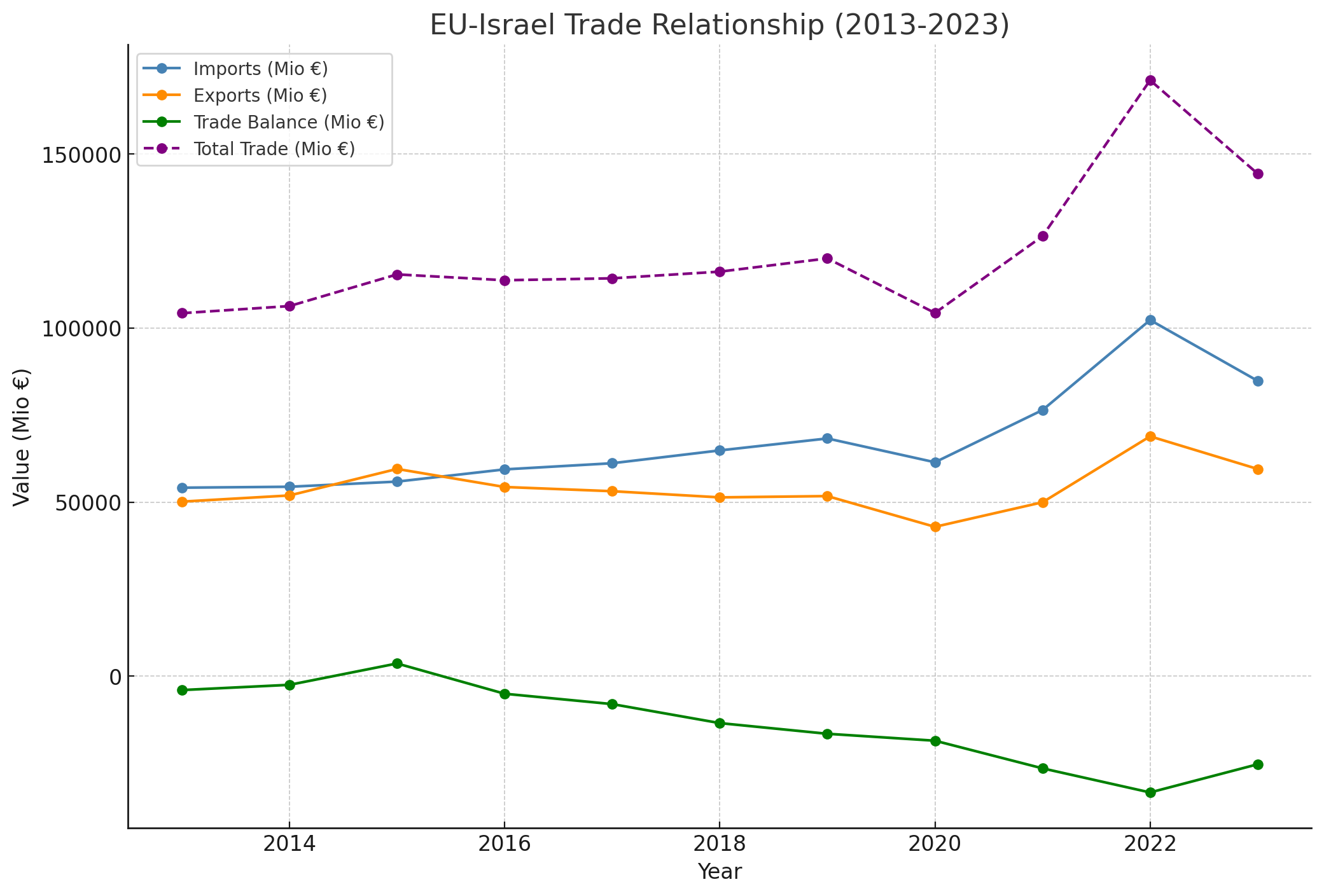
- Increase Diplomatic Pressure for a Ceasefire: The EU must adopt a more assertive diplomatic stance in advocating for an immediate ceasefire. This may involve strengthened coordination with key international stakeholders, particularly the United States, Egypt, and Jordan, to mediate discussions between Israel and Hamas. Economic ties with Israel complicate the EU’s stance, as member states with significant trade relationships are often reluctant to take actions that might negatively affect these ties. As Israel’s largest trading partner, with €37.4 billion in trade in 2022, the EU could leverage this by imposing human rights conditions on future agreements (Eurostat, EU-Israel Trade Relations 2023). Chart for EU and Israeli trading presented after the recommendations. On April 12, 2024, new EU laws criminalised practices such as circumventing sanctions, with penalties including imprisonment for intentional offences. These principles should also apply to Israel, ensuring that EU sanctions are consistently enforced ( European Council , 2024 ) .
Long Term Recommendations
- Renewed Push for a Two-State Solution with Conditions: The EU should reframe its support for the two-state solution, imposing conditionality on its continued backing based on demonstrable progress in negotiations. With Israeli settlements growing by 40% between 2022 and 2023, stopping future expansion should be a requirement for EU cooperation (OCHA Reports, 2024) . This approach should include stronger sanctions against Israeli settlement expansion and ensure that any future peace agreements adequately address the humanitarian rights of Palestinians, particularly in Gaza.
- Establish an EU Special Envoy for Gaza: Given the unique challenges inherent in Gaza, the EU should appoint a special envoy dedicated to addressing the specific humanitarian and political complexities of the region. The Special Envoy for Gaza could help international parties coordinate their efforts, establishing a united approach and successfully addressing the region’s diverse needs. This envoy would collaborate closely with Palestinian and Israeli authorities, as well as international organisations, to coordinate aid efforts and facilitate diplomatic dialogue.
Conclusion
The Israel-Palestine conflict, notably the Gaza humanitarian tragedy, challenges the EU’s foreign policy framework. A balanced strategy is required, combining immediate assistance with long-term diplomatic initiatives. This situation affects not only Gaza but also the West Bank and regional stability, particularly in Lebanon, where Irish peacekeepers face increasing risks from Israel Defense Forces (IDF) despite adhering to UN rules (Department of Defence, 2023). The EU must improve its strategy by negotiating humanitarian access, leveraging commerce to press for a cease-fire, and working with partners. Long-term, EU support for a two-state solution should be contingent on limiting settlement expansion, including economic sanctions if required. Ultimately, the EU’s internal challenges, stemming from political, ideological, and economic factors, undermine its capacity to take meaningful action in the Israel-Palestine conflict. Additionally, by appointing an EU Special Envoy for Gaza will enhance coordination and strengthen the EU’s commitment to peace.
Bibliography
Books & Journal Articles
Ahmed, T. and Butler, I.J., 2006. ‘The European Union and Human Rights: An International Law Perspective’, European Journal of International Law, 17(4), pp. 771–801.
Brown, B., 2019. ‘The Israeli–Palestinian Conflict’, World Affairs: The Journal of International Issues*, 23(3), pp. 58-65.
Hug, A. (Ed.), 2013. Europe in the World: Can EU Foreign Policy Make an Impact? Foreword by Rt Hon Douglas Alexander MP. The Foreign Policy Centre, pp. 4-15.
Miller, A. D., 2023. ‘Why the Oslo Peace Process Failed and What It Means for Future Negotiators’, *Foreign Policy*, 13 September. Available at: https://foreignpolicy.com/2023/09/13/oslo-accords-1993-anniversary-israel-palestine-peace-process-lessons/ [Accessed 8 November 2024].
Shlaim, A., 1994. ‘The Oslo Accord’, *Journal of Palestine Studies*, 23(3), pp. 24–40.
Tessler, M., 2009. *A History of the Israeli-Palestinian Conflict*. Indiana University Press, pp. 679-754.
Reports, Websites & Online Resources
Department of Defence, 2023. ‘Statement by Tánaiste and Minister for Defence Micheál Martin on the Situation in Lebanon’. Available at: https://www.gov.ie/en/press-release/37638-statement-by-tanaiste-and-minister-for-defence-micheal-martin-on-the-situation-in-lebanon/ [Accessed 8 October 2024].
Eurostat, 2023. ‘EU-Israel Trade Relations’. Available at: https://ec.europa.eu/eurostat/statistics-explained/index.php?title=EU_-_Israel_trade_in_goods_statistics [Accessed 8 October 2024].
European Council, 2024. *Why the EU adopts sanctions*. [online] Available at: https://www.consilium.europa.eu/en/policies/why-sanctions/ [Accessed 8 November 2024].
European External Action Service (EEAS), 2024. The EU and the Middle East Peace Process. [online] Available at: https://www.eeas.europa.eu/eeas/eu-and-middle-east-peace-process_en [Accessed 8 November 2024].
International Crisis Group, n.d. ‘Egypt and the Israel-Palestine Conflict: A Mediator’s Role’. Available at: https://www.crisisgroup.org/middle-east-north-africa/israel-palestine/egypt-and-israel-palestine-conflict-mediators-role [Accessed 8 October 2024].
Kül-Açıkmeşe, S. and Özel, S., 2024. *EU Policy towards the Israel-Palestine Conflict: The Limitations of Mitigation Strategies*. Kadir Has University, Istanbul. Available at: https://doi.org/10.1080/03932729.2024.2309664 [Accessed 8 October 2024].
OCHA, 2024. ‘Occupied Palestinian Territory’. Available at:OCHA Report: Responding to emergency needs amidst shrinking humanitarian space in the Occupied Palestinian Territory – January to June 2024 – Question of Palestine. [Accessed 8 October 2024].
United Nations Relief and Works Agency for Palestine Refugees in the Near East (UNRWA), 2023. ‘Annual Report 2023’. Available at: https://www.unrwa.org/resources/annual-report-2023 [Accessed 8 October 2024].
World Food Programme (WFP), 2023. ‘WFP Gaza Emergency Response: Annual Report 2023’. Available at: https://www.wfp.org/publications/gaza-emergency-response-report-2023 [Accessed 8 October 2024].
World Health Organization (WHO), 2024. ‘Occupied Palestinian Territory: Public Health Situation Analysis, 7 October 2023–30 April 2024’. Available at: https://www.un.org/unispal/wp-content/uploads/2024/05/WHO-PHSA-oPt-020524-FINAL.pdf [Accessed 8 October 2024].

