
This policy brief was written for INRL20160 Introduction to EU Politics at University College Dublin during the 2025/26 academic year. The module asks students to identify a live problem on the EU agenda, weigh the options open to the Union, and set out concrete recommendations. The brief is reproduced here as submitted, and the views expressed are the author’s own.
Executive summary
As a response to the ongoing climate change crisis and its drastic effects, the European Union Council presented the European Green Deal (EGD) in 2019. Its main aim was to transform Europe into the first carbon-zero continent by 2050. However, the transformation would impact and harm many regions and citizens dependent on coal or fossil fuels. This led to the adoption of the Just Transition Mechanism in 2020. With the mobilisation of €55 billion over the period 2021-2027, the JTM funds transition projects and eases the socio-economic impacts. Despite its success, it fails to recognise the effect climate change has on minority groups. Furthermore, it lacks in the areas of accountability and transparency. The policy recommendations aim to solve these issues by suggesting the continuation of the JTM in the next Multiannual Financial Framework (MFF). It needs to include stronger local and regional governance while offering social support for minorities. To ensure transparency and monitoring, it needs to strengthen the involvement of stakeholders. Finally, it needs to be prioritised in the EGD and future climate change policies.
Context and Importance
In recent years, the European Union has taken steps to combat climate change and its consequences. Climate change is one of the most pressing issues in today’s climate, with effects such as frequent and extreme weather (Consilium.europa.eu, 2025). Resulting in devastating consequences such as fatal wildfires, water scarcity and climate migration within Europe.
The EU is fully dependent on a functioning environment and ecosystem. As a response to these crises, the EU Council presented the EGD in December 2019. It became the EU’s main instrument for combating the climate and environmental crisis, shifting the EU towards a sustainable development path (Consilium.europa.eu, 2025).
The European Commission emphasised its goal in the EDG to transition to a zero-carbon society by 2050 in a fair way and leaving no one behind, grounded in the principle of Just Transition (JT). Due to the close interaction of social justice and the fight for climate change, many carbon-intensive and coal mining regions will be negatively affected by the transition to a low-carbon economy (Di Rosa et al.,2025). This transition will impact social and economic levels in various ways: regional, sectoral, and distributional. It will lead to unemployment, energy and transport poverty, migration, and income loss (Marcu et al., 2022). To ensure that the EDG becomes a reality, it must secure the full support of everyone involved. Therefore, it must show solidarity with affected regions (Commission.europa.eu, n.d.).
Critique of Policy Options
The Just Transition Mechanism was adopted in January 2020 to ensure the just transition of the EGD. The JTM ensures the mobilisation of €55 billion over the period 2021-2027, which will reduce the socio-economic impacts of the transition in fossil fuel-dependent regions, citizens vulnerable to the transition, and companies and/or sectors operating in carbon-intensive industries. The JTM provides financial assistance for re-skilling, employment, renewable energy, social cohesion, and loans to companies. Due to the large scope of affected areas, the JTM fund is split into three pillars: the Just Transition Fund (JTF) supports the most affected territories by providing tailored support, the InvestEU “Just Transition” scheme provides a budgetary guarantee, and the Public Sector Loan Facility (Commission.europa.eu, n.d.).
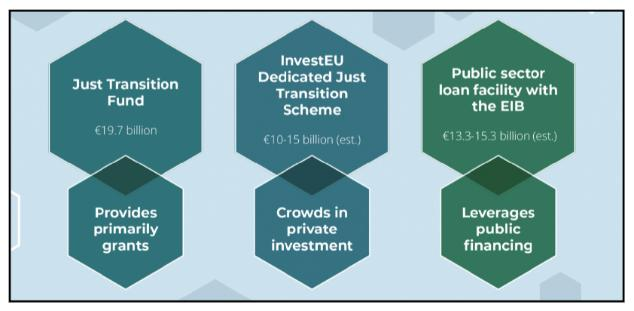
The JTM has been successful and effective in its implementations. It has triggered the industry’s decarbonisation process and coal phase-outs in dependent regions to a moderate to large extent. Furthermore, members of the JTM Working Group noted the effectiveness in supporting and funding a variety of projects (Working Group, 2025).
Despite its successes, the EDG and JTM fail to make a clear link between the transition and social justice. Having been criticised as being superficial and with scarce social measures (Casamenti and Mejías, 2021). While focusing on economic equity, it fails to recognise the significance of gender, ethnicity, age, and disability. These vulnerable groups are the first to feel the consequences of climate change and the transition (Di Rosa et al.,2025). Secondly, there are unequal governance frameworks in place between the Member States. Some regions lack accountability, transparency, and an inclusive dialogue. Additionally, some have insufficient collaboration between national and local regions and stakeholders (Marcu et al., 2022).
Policy Recommendations
- The JTM needs to be continued without hindrance to its implementation. Therefore, amendments need to be made in the Commission’s proposal of the 2028-2034 MFF. The proposal includes a €2 trillion budget, 35% going to climate and environmental measures (Climate.ec.europa.eu, 2025). The merging of environmental and climate funds weakens their focus and makes tracking and accessing harder. The JTF needs its own budget and assigned funds for JT regions to be effective. Approval of this amendment is challenging due to pushback from countries, due to their own spending constraints (Europe-on.org, 2025).
- The JT needs to include people more in the decision-making process and its policies. They need to expand the definition of vulnerability, considering gender, race, and disability, instead of only economic terms (Di Rosa et al.,2025). Stronger direct regional and local engagement and authority, with relevant knowledge, is vital to ensure that protective measures for vulnerable groups are being taken (Working Group, 2025). This can be challenging due to insufficient JTM funding and its focus on economic and corporate matters.
- Strengthening the involvement of stakeholders, such as trade unions, NGOs, and youth associations, is essential for improving the JT’s effectiveness. Closer cooperation and more transparency with stakeholders would result in a structured feedback mechanism and close monitoring (Working Group, 2025). This transparency and feedback mechanism could encourage more funding from existing and new stakeholders.
- Policies, programmes, and strategies within the JT need to be ‘developed, adapted, and adopted’ in all Member States, regions, and within every sector (Casamenti and Mejías, 2021). The JT must be adapted to upcoming policies and legislation regarding climate change and energy. (Group, 2025). There are financial limits regarding applying it to all sectors. Furthermore, this can only be done after the previous recommendation has been implemented to avoid an increase in minority discrimination.
Bibliography
Casamenti, A, and Mejías, C.R. (2021). European Green Deal: A Strategy Fit For A Socially Just Transition? [online] Solidar. Available at: https://www.solidar.org/news-and-statements/briefing-paper-100-european-green-deal/ [Accessed 7 November 2025].
Climate.ec.europa.eu (n.d.) Supporting climate action through the EU budget. Available at: https://climate.ec.europa.eu/eu-action/eu-funding-climate-action/supporting-climate-action-through-eu-budget_en [Accessed 7 November 2025].
Consilium.europa.eu (2025) European Green Deal. Available at: https://www.consilium.europa.eu/en/policies/european-green-deal/#what [Accessed 5 November 2025].
Consilium.europa.eu (n.d.) Climate change: what the EU is doing. Available at: https://www.consilium.europa.eu/en/policies/climate-change/ [Accessed 5 November 2025].
Commission.europa.eu (n.d.) Just Transition funding sources. Available at: https://commission.europa.eu/strategy-and-policy/priorities-2019-2024/european-green-deal/finance-and-green-deal/just-transition-mechanism/just-transition-funding-sources_en [Accessed 5 November 2025].
Commission.europa.eu (n.d.) The Just Transition Mechansim: making sure no one is left behind. Available at: https://commission.europa.eu/strategy-and-policy/priorities-2019-2024/european-green-deal/finance-and-green-deal/just-transition-mechanism_en#who-will-benefit [Accessed 7 November 2025].
Di Rosa, A. et al. (2025) The Just Transition Mechanism: Making Sure No One Is Left Behind. [online] SciencesPo. Available at: https://www.sciencespo.fr/psia/chair-sustainable-development/2025/06/24/the-just-transition-mechanism-making-sure-no-one-is-left-behind/ [Accessed 7 November 2025].
Europe-on.org. (2025) The European Commission has released its proposal for the 2028-2034 Multiannual Financial Framework…What are the reactions in Brussels? Available at: https://europe-on.org/2025/07/29/the-european-commission-has-released-its-proposal-for-the-2028-2034-multiannual-financial-framework-what-are-the-reactions-in-brussels/ [Accessed 7 November 2025].
Fetting, C. (2020). The European Green Deal. ESDN Report, December 2020, Vienna: ESDN Office.
Marcu, A., Monciatti, M, and Cesaro, P. (2022). Unlocking the governance challenges of Just Transition in the EU. [online] European Roundtable on Climate Change and Sustainable Transition. Available at: https://ercst.org/wp-content/uploads/2022/03/Unlocking-the-governance-challenges-of-Just-Transition-in-the-EU-v10.pdf [Accessed 5 November 2025].
Working Group (2025). Adapting the Just Transition Mechanism to the needs of regions in transition. [online] The Just Transition Platform Working Group on Future of Just Transition. Available at: https://ec.europa.eu/regional_policy/sources/funding/just-transition-fund/jtp-future-working-group-toolbox.pdf [Accessed 7 November 2025].

